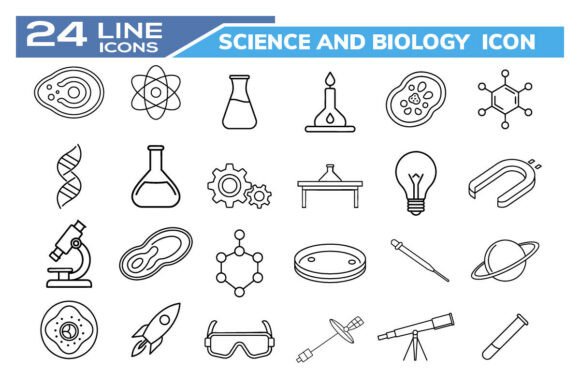
Science and Biology Vector Icon Set
When you are building educational materials, designing a medical app, or putting together a presentation for a biology class, the visuals you choose matter more than you might think. A well-made icon set can save you hours of work and make your project look polished and professional. But not all vector icon sets are created equal, and many people end up with files that do not work the way they expected. If you are considering a Science and Biology Vector Icon Set for your next project, there are a few things you should know before you download or buy.
Why people turn to science icon sets in the first place
Most people searching for a Science and Biology Vector Icon Set are looking for a quick, affordable way to add visual clarity to their work. You might be a teacher building a worksheet, a blogger writing about lab techniques, or a startup founder designing a health app. The appeal is obvious: ready-made icons save you from hiring an illustrator or spending hours drawing your own test tubes and DNA strands. The line art style, in particular, has become popular because it looks clean, modern, and scales well across different screen sizes and print formats.
But here is where many people get tripped up. They assume all icon sets are interchangeable, or that any set will work straight out of the box. That assumption often leads to frustration, wasted time, and disappointing results.
Mistake one: choosing style over substance
It is easy to fall in love with a set that looks beautiful in the preview. The thin lines, the consistent stroke width, the elegant curves. But beauty alone does not make an icon set useful. A common oversight is not checking whether the set includes the specific icons you actually need. You might find a gorgeous Science and Biology Vector Icon Set that has a dozen variations of a microscope but no simple cell diagram or plant structure. That mismatch forces you to either improvise with icons that do not quite fit or spend extra time hunting for a supplement set.
Before you commit to any set, make a short list of the icons you will use most. If you are building content about genetics, you need more than a DNA helix. You might need chromatids, nucleotide bases, or chromosome pairs. If the set only covers general biology topics, you will run into gaps. Look for a collection that lists every icon by name, not just by category. A good Science and Biology Vector Icon Set will include educational staples like atoms, molecules, test tubes, plants, organs, and laboratory equipment. But verify that the specific subjects you cover are represented.
Mistake two: ignoring file format limitations
Another frequent mistake is not checking which file formats are included before downloading. Many people assume that if they can open the file on their computer, it will work everywhere. In reality, different projects demand different formats. If you are working in web design, SVG files are essential because they scale cleanly without losing quality. If you are producing printed materials, EPS or AI files give you full editability in vector software like Adobe Illustrator. PNG files are useful for quick use in slides or documents, but they are not truly scalable.
A professional Science and Biology Vector Icon Set should offer multiple formats. Look for AI, SVG, EPS, and PNG options at minimum. If the seller only provides one format, you may find yourself unable to edit the stroke weight, change colors, or resize without distortion. That limitation can derail your entire design workflow. Always confirm that the set is fully editable and scalable in the formats you actually need.
Mistake three: overlooking consistency in line weight and style
Even within a single set, icons can vary in line weight, corner rounding, and level of detail. A well-constructed Science and Biology Vector Icon Set maintains consistent visual properties across every icon. When line weights fluctuate, the set looks disjointed, and your project loses its professional polish. I have seen presentation slides where the DNA icon had a thin stroke while the beaker icon was noticeably thicker. That small inconsistency distracts the audience and undermines the credibility of the content.
Before you purchase or download a set, examine the previews closely. Look at icons side by side. Check the thickness of the lines, the spacing between elements, and the overall visual balance. If the set does not include a preview showing multiple icons together, that is a red flag. The best sets provide a full icon grid so you can assess consistency at a glance. If you are designing for clients or a public audience, consistency in icon style is not optional. It is a basic expectation.
Mistake four: misunderstanding licensing and usage rights
Licensing is one of the most overlooked aspects when choosing a Science and Biology Vector Icon Set. Many designers and educators assume that because they paid for the set, they can use it however they want. That is not always true. Some icon sets come with restrictions on commercial use, redistribution, or modification. You might be allowed to use the icons in a textbook but not in a mobile app. You might be able to modify the colors but not the shapes. Or you might be required to credit the creator in a specific way.
If you plan to use the icons in a product you sell, such as a course, an ebook, or a software interface, check the license terms carefully. The safest option is a set with a permissive commercial license that allows modification and redistribution without extra fees. Avoid sets that restrict use to personal projects only, unless that truly matches your needs. Taking the time to read the license now can save you from legal headaches or having to replace every icon later.
Mistake five: neglecting real-world testing before full use
Even after you have chosen a Science and Biology Vector Icon Set, it is wise to test a few icons in your actual project environment before you commit to the whole collection. Import a couple of icons into your design software, resize them to the dimensions you need, and check how they look at both small and large scales. Some icons that appear detailed and clear in a preview become muddy or cluttered when scaled down for mobile screens. Others lose detail when printed at small sizes.
Test the icons in the context where they will be seen. If you are building an infographic, place the icons next to your text and see how they interact. If you are designing a mobile app interface, check how the icons look on a real device. This testing step takes only a few minutes but can reveal problems that are invisible in the sales preview. A reliable set will hold up well under different conditions, but you should verify that for yourself rather than assume.
How to choose the right set from the start
To avoid these common mistakes, start by clarifying what you need. Make a list of required icons, preferred file formats, and the context where the icons will appear. Then look for a Science and Biology Vector Icon Set that matches those requirements rather than making your project conform to the set. Read the product description thoroughly and check for specifics about the number of icons, the included formats, and the license terms.
Look for customer reviews or sample downloads if they are available. Real feedback from other users often reveals whether the set is truly editable, whether the icons are well-organized, and whether the quality matches the previews. An experienced seller will provide clear documentation and responsive support if you have questions.
Also consider the future. If you think you might need additional icons later, check whether the set is part of a larger collection that you can expand on. Some creators offer themed packs that complement each other, which can be more cost-effective than buying unrelated sets down the line.
The value of a well-chosen icon set
When you select the right Science and Biology Vector Icon Set, the benefits go beyond saving time. Your materials become more accessible and easier to understand. A clear icon can communicate a concept faster than text alone, especially in educational or medical contexts where precision matters. Consistent, high-quality icons also build trust with your audience. Whether you are designing for students, patients, or professional colleagues, thoughtful visuals signal that you care about the details.
And because modern line art icons are minimal by nature, they tend to stay visually relevant longer than heavily styled illustrations. A clean set of biology and science icons can serve you across multiple projects and platforms for years, provided you chose wisely from the beginning.
Take the time to evaluate your options, test the files, and read the fine print. That small investment upfront will pay off every time you drop an icon into a layout and see it fit exactly as you imagined.