The Essential Guide to Engine Accessories Tools Outline Icons in Modern Automotive Design
When you crack open a car repair manual or browse a mechanical infographic, the first thing that catches your eye is often the clarity of the visuals. In technical communication, precision isn't just about the words on the page—it's equally about the imagery that supports them. This is where the Engine Accessories Tools Outline Icon comes into play. These clean, minimalist vector illustrations have become the backbone of how we communicate complex mechanical concepts, from pistons and crankshafts to alternators and full engine blocks. Whether you're designing a garage brand identity, building an automotive website, or producing training materials, understanding the role and application of these icons can transform your work from cluttered to crystal clear.
Why Outline Icons Dominate Technical Illustration
There's a reason why outline icons have become the standard in automotive documentation: they strip away the noise. When you look at a detailed photograph of an engine, there are shadows, reflections, overlapping parts, and a hundred distracting details. An outline icon, by contrast, isolates the essential form. It shows you the shape of a piston, the curve of a crankshaft, or the housing of an alternator without any visual clutter. This reductionist approach is not an artistic choice—it's a functional necessity.
For mechanics and engineers, time is often in short supply. A well-crafted Engine Accessories Tools Outline Icon allows the viewer to immediately identify a component, understand its relationship to other parts, and grasp the flow of assembly or repair. The cognitive load is low because the image communicates directly. In the world of automotive repair manuals, where a misinterpreted diagram can lead to costly mistakes, this clarity is invaluable.
Moreover, outline icons scale beautifully. A vector illustration of an engine block remains crisp whether it's printed on a poster or displayed on a smartphone screen. This scalability makes them ideal for responsive automotive websites, where the same icon needs to work in a desktop sidebar and a mobile navigation menu. The consistent stroke weight and uniform style also create visual harmony across a set of icons, which is critical for professional branding.
Key Components in the Engine Accessories Toolkit
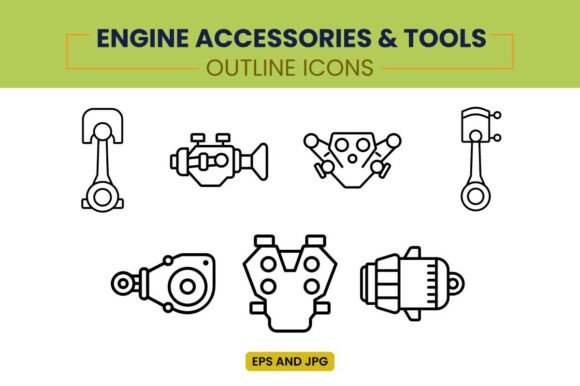
When we talk about engine accessories tools outline icons, we're referring to a specific visual language that covers the most common and critical engine components. Let's break down what you'll typically find in a well-designed set and why each one matters.
Pistons and Crankshafts: The Heart of Motion
Pistons are perhaps the most recognizable symbol of internal combustion. An outline icon of a piston typically shows the cylindrical body, the connecting rod, and the piston pin. The simplicity of the line drawing allows the viewer to focus on the geometry—the precise relationship between the piston head and the cylinder wall. In a repair manual, this icon might be used to indicate a piston ring replacement procedure or to highlight the piston assembly in an exploded view.
Crankshafts, with their distinctive offset journals and counterweights, present a more complex shape. A good outline icon captures the rotational symmetry and the offset throws without becoming a tangled mess of lines. This is important because the crankshaft's function—converting linear piston motion into rotational force—is fundamentally about geometry. The icon needs to communicate that shape instantly. When you see a clean vector of a crankshaft, you're seeing the mechanical logic of the engine distilled into its purest form.
Alternators and Electrical Components
Modern engines are as much about electricity as they are about combustion. Alternators, starters, and sensors all play critical roles. An alternator outline icon typically features the cylindrical housing, the pulley at one end, and sometimes the cooling fins or electrical terminals. The challenge here is to differentiate the alternator from other cylindrical components like the AC compressor or the power steering pump. Effective icon design uses subtle cues—the shape of the pulley, the placement of the electrical connector, or the pattern of the cooling fins—to make each component instantly recognizable.
For an automotive website selling replacement parts, having a distinct Engine Accessories Tools Outline Icon for each electrical component can dramatically improve user experience. A customer looking for an alternator can scan a list of icons and find the right part in seconds, without needing to read through paragraphs of text. This visual shorthand is not just convenient—it reduces errors and increases conversion rates.
Engine Blocks: The Foundation
The engine block is the largest and most structurally complex component. An outline icon of an engine block needs to convey the core architecture—the cylinder bores, the water jacket passages, the mounting points, and the main bearing journals. This is a challenging subject for a line drawing because the block is essentially a three-dimensional casting with intricate internal cavities. The best icons simplify this by showing the block in a semi-exploded or cutaway view, revealing just enough internal detail to communicate the function.
In technical illustrations, the engine block icon often serves as the anchor around which other component icons are arranged. It provides the spatial reference that helps the viewer understand how pistons, crankshafts, and timing chains fit together. Without a clear block icon, the entire diagram loses its structural context. This is why a high-quality vector set for automotive applications always includes a well-crafted engine block illustration.
Practical Benefits for Automotive Professionals and Brands
The adoption of outline icons extends far beyond the pages of repair manuals. In today's digital-first environment, automotive businesses of all sizes are leveraging these visuals to improve communication and branding. Here are some of the most impactful applications I've observed:
- Garage branding and signage: A clean, modern icon set can define the visual identity of an auto repair shop. Using consistent engine accessory outline icons on your website, business cards, and service menus creates a professional, trustworthy appearance. Customers associate this clarity with competence.
- E-commerce product categorization: Online auto parts retailers use icons to help customers navigate thousands of SKUs. A piston icon next to "Engine Parts" and an alternator icon next to "Electrical Systems" makes browsing intuitive. This reduces bounce rates and helps customers find what they need.
- Training and educational materials: Technical schools and training programs rely on outline icons to teach engine fundamentals. The simplified forms help students focus on function rather than surface detail. An instructor can point to a crankshaft icon and explain journal offset without the distraction of shadows and reflections.
- Mobile apps and diagnostic tools: In the workshop, mechanics use tablets and smartphones with diagnostic software. Screen real estate is limited, and icons need to be legible at small sizes. Vector outline icons perform exceptionally well here because they remain sharp and distinct even when scaled down.
One observation worth noting is the growing trend toward animated SVG icons in digital interfaces. A static Engine Accessories Tools Outline Icon is already powerful, but adding subtle motion—like a piston cycling or a crankshaft rotating—can take user engagement to another level. This is particularly effective in web-based training modules or interactive parts catalogs. The animation doesn't just look good; it reinforces the mechanical function of the component.
What to Look for When Choosing Icon Sets
Not all outline icon sets are created equal. If you're sourcing vector illustrations for a project, there are a few qualities you should carefully evaluate. First, consider consistency of stroke weight. A well-designed set uses the same line thickness across all icons, which creates visual coherence. When icons from the same set are used together, they should feel like they belong to a unified system. Mixed stroke weights look amateurish and can confuse the viewer.
Second, pay attention to proportional accuracy. The icons don't need to be photorealistic, but they should respect the basic proportions of the real components. An alternator that looks too large relative to a piston will throw off the visual logic of a diagram. Good icon design balances artistic simplification with mechanical truth. The best sets are created by illustrators who understand automotive engineering, not just graphic design.
Third, check for modularity and adaptability. In many projects, you'll need to combine icons, overlay them, or place them in different orientations. Vector files that are well-organized into layers and groups make this editing process much smoother. You should be able to change stroke colors, adjust line weights, or rotate an icon without breaking the design. This flexibility is essential for branding applications where you need to match specific color schemes.
Finally, consider the scope of the set. A comprehensive collection of engine accessories tools outline icons will include not only the major components but also smaller items like oil filters, timing chains, gaskets, and fasteners. Having a complete vocabulary of icons allows you to build detailed diagrams without resorting to mismatched visuals from different sources. In my experience, investing in a larger set upfront saves significant time and frustration down the road.
Integrating Icons into Real-World Workflows
Let me offer a practical scenario. Imagine you're redesigning the service menu for a chain of independent repair shops. The old menu was text-heavy and confusing to customers. You decide to replace it with a modern, icon-driven layout. For each major service category—oil change, brake inspection, engine diagnostic—you use a relevant outline icon. The engine diagnostic category uses a stylized engine block icon with a warning symbol overlay. This simple change makes the menu instantly scannable. Customers can find the service they need in seconds, and the visual consistency builds trust.
In another scenario, consider an automotive blog that publishes technical how-to articles. Instead of relying solely on photographs of dirty, greasy engines, the blog incorporates clean vector icons to illustrate steps. A piston icon appears next to the section about compression testing, and a crankshaft icon marks the timing belt replacement procedure. Readers appreciate the clarity, and the articles become more shareable on social media because the visuals are clean and professional. The Engine Accessories Tools Outline Icon becomes a signature element of the blog's brand identity.
For those working in instructional design, outline icons offer a way to standardize training across different languages. A visual dictionary of engine components built entirely with icons can be understood by a mechanic in any country, regardless of their native language. This is particularly valuable for multinational automotive companies that need to deliver consistent training to global teams. The icons transcend linguistic barriers, making technical knowledge more accessible.
Final Observations on This Visual Language
The rise of the outline icon in automotive communication is not a passing trend. It's a response to a genuine need for clarity in an increasingly visual world. As engines become more complex—with hybrid systems, variable valve timing, and electronic controls—the challenge of communicating how they work grows. Outline icons meet this challenge by distilling complexity into elegant, readable forms. They are not a substitute for detailed engineering drawings, but they are an essential tool for the everyday communication that keeps the automotive industry running.
Whether you're a mechanic building a personal brand, a designer creating a website, or a trainer developing a curriculum, the choice to use vector outline icons is a choice to prioritize your audience's understanding. The Engine Accessories Tools Outline Icon is more than a graphic—it's a bridge between technical knowledge and practical application. When you use it well, you make the complicated seem simple, and that is the highest goal of any good communication tool.