Metaverse 3D Icon Pack: Designing the Visual Language of Virtual Worlds
As digital environments grow more immersive, the tools we use to navigate them are evolving rapidly. The Metaverse 3D Icon Pack has emerged as a practical resource for designers, developers, and content creators who need cohesive visual elements that feel at home in virtual and augmented reality spaces. This collection goes beyond traditional flat icons, offering three-dimensional objects with a distinctive colorful chubby style that balances approachability with futuristic appeal. Whether you are building a VR interface, designing an NFT gallery mockup, or preparing slides for a gaming conference, these assets provide a ready-made visual shorthand for the core concepts of the metaverse.
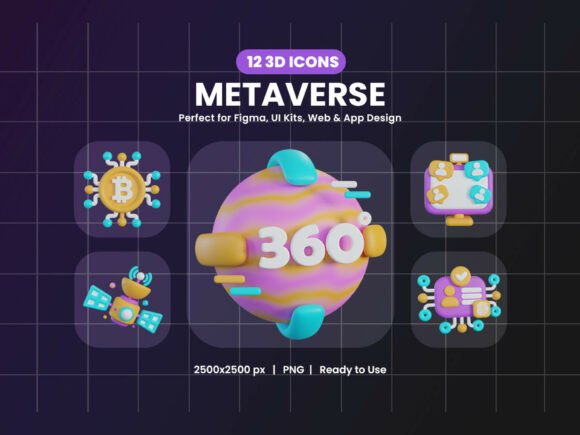
What makes this icon pack particularly relevant today is the growing demand for visuals that communicate complex ideas quickly. A VR headset, an avatar figure, a crypto coin, a holographic display, and a glowing portal are no longer niche symbols. They represent the fundamental building blocks of how people interact, transact, and socialize in digital worlds. By offering these elements as high-resolution 3D renders and OBJ model files, the pack bridges the gap between static design and interactive prototyping.
Why Visual Consistency Matters in Immersive Environments
The metaverse is not a single platform but an expanding ecosystem of interconnected digital spaces. This fragmentation creates a challenge for designers: how do you maintain a coherent visual language when your assets might appear in a VR lobby, a web-based marketplace, a mobile AR app, and a social game hub? The Metaverse 3D Icon Pack addresses this by providing a unified aesthetic that works across different contexts without feeling generic.
Each of the twelve icons shares the same smooth geometry, soft lighting, and restrained color palette. This consistency helps users recognize familiar functions—like connecting to a wallet or customizing an avatar—regardless of where they encounter them. For UI/UX professionals working on metaverse platforms, this kind of predictability reduces cognitive load and makes interfaces feel intuitive from the first interaction.
Moreover, the chubby style is a deliberate departure from the cold, industrial look that once dominated tech visuals. The rounded forms and warm tones invite exploration rather than intimidation. This matters because virtual worlds are still new to a large portion of potential users. Design choices that feel welcoming can lower barriers to entry and encourage broader adoption.
The Shift Toward 3D Iconography in Modern Interface Design
Flat design has dominated digital interfaces for over a decade, but the pendulum is swinging back toward depth and dimensionality—especially in contexts where the interface itself is part of a three-dimensional environment. When a user puts on a VR headset, they are no longer looking at a flat screen. Their perception is volumetric, and icons that lack depth can feel out of place against a 360-degree backdrop.
The Metaverse 3D Icon Pack – Colorful Chubby Style aligns with this shift by offering OBJ 3D model files alongside standard PNG renders. This dual format is significant. The PNGs are ready for immediate use in presentations, websites, or social media posts. The OBJ files, on the other hand, allow developers to import the icons directly into 3D engines like Unity, Blender, or Unreal Engine. There, they can be scaled, rotated, lit, and animated to match the specific needs of a project.
This flexibility reflects a broader change in how digital assets are produced. Designers no longer think in terms of static images alone. They plan for interactivity, responsiveness, and spatial placement. A hologram icon that looks great on a landing page should also look convincing when floating next to a virtual character. By providing both formats, the pack acknowledges that modern workflows are hybrid, moving seamlessly between 2D and 3D environments.
Practical Applications Across Professional Domains
The versatility of this icon set makes it useful for a wide range of professionals, each with distinct needs.
UI and UX Designers Working on Immersive Interfaces
For designers tasked with creating interfaces for VR or AR platforms, the icons serve as placeholders or final assets that communicate function without relying on text labels. In a spatial interface, text can be difficult to read at certain angles or distances. Icons bridge that gap. The inclusion of a VR headset icon, for instance, can label a settings menu for display options, while a crypto coin icon can indicate a user’s balance in a decentralized wallet. The transparent background of each PNG simplifies compositing into different layouts, and the high 2500x2500 pixel resolution ensures crisp rendering even on large screens or when viewed up close in VR.
Game Developers and Virtual World Builders
Prototyping a game environment often requires materials that communicate theme and mood before the final art is ready. The colorful chubby style of these icons fits well in casual game settings, educational simulations, or social hubs where a friendly tone is important. Developers can drop the OBJ files into a scene to mark teleportation points, inventory slots, or achievement milestones. Because the models are already optimized for 3D use, they save hours of modeling time during early development phases.
NFT and Crypto Project Creators
In the NFT space, visual presentation can make or break a project. The icon pack includes symbols like the crypto coin and the portal, which are central to many blockchain-based experiences. Whether used in a roadmap graphic, a whitepaper, or a promotional banner, these assets lend a polished look that signals professionalism. The pack does not include fonts, but the documentation provides links to free typography resources, allowing creators to pair the icons with suitable typefaces without incurring additional costs.
Marketers and Content Creators Covering Emerging Tech
Bloggers, educators, and journalists who write about the metaverse often struggle to find visuals that are both accurate and licensed for use. Stock photography of VR headsets is ubiquitous, but custom 3D icons that represent abstract concepts like “digital identity” or “virtual economy” are harder to come by. This pack fills that gap. A marketer preparing a presentation on metaverse trends can use the avatar icon to represent personalization, the hologram icon for communication, and the portal icon for entry into virtual spaces. The cohesive style makes the slide deck look deliberate and well-produced rather than patched together from disparate sources.
How the Colorful Chubby Style Reflects Changing User Expectations
There was a time when futuristic design meant sharp edges, metallic textures, and monochromatic color schemes. That aesthetic conveyed power and innovation but also felt distant and impersonal. Over the past few years, a countertrend has emerged: softer, more expressive visuals that prioritize emotional connection over pure technological spectacle.
The Metaverse 3D Icon Pack – Colorful Chubby Style is a clear example of this shift. The rounded shapes and saturated but balanced colors evoke a sense of playfulness and accessibility. This is not a style that screams “cutting-edge laboratory.” It whispers “welcoming digital playground.” For brands targeting mainstream audiences—people who may not be early adopters but are curious about virtual experiences—this approach is more effective than a cold, industrial look.
The style also ages well. While hyper-realistic 3D renders can look dated as rendering technology improves, stylized geometry maintains its appeal because it does not aim for realism in the first place. Characaturized proportions and deliberate color choices create a timeless quality that keeps the icons usable for years.
Practical Recommendations for Getting the Most Out of This Asset Pack
To fully leverage the potential of this icon set, consider the following approaches.
- Use the OBJ files for prototyping interactions. The 3D models can be imported into spatial design tools and used as clickable or hoverable elements in an interactive prototype. This gives stakeholders a more realistic sense of the final experience than static mockups can provide.
- Combine the icons with a consistent color palette for branding. While the pack comes with its own colors, you can change the materials in the OBJ files to match your brand guidelines. This allows you to maintain the chubby silhouette while aligning with existing visual identity.
- Scale the PNGs for different contexts. The 2500x2500 pixel resolution gives you room to resize without losing quality. Use the full-resolution versions for hero graphics and smaller crops for in-app icons or social media thumbnails.
- Pair with free fonts from the documentation. The pack does not include typefaces, but the linked resources are carefully selected to complement the chubby style. A rounded sans-serif font works particularly well to maintain visual harmony.
- Consider animation potential. The OBJ models can be animated with rotation pulsing, or scale changes to add dynamism to a web page or presentation. Even subtle movement makes icons feel more alive in digital spaces.
Why This Icon Pack Represents a Broader Creative Evolution
The rise of the Metaverse 3D Icon Pack is not just about the availability of new assets. It reflects a deeper evolution in how we think about digital environments. Ten years ago, designing for the web meant thinking about pixels, breakpoints, and browser compatibility. Today, designing for the metaverse means thinking about spatial depth, user agency, and cross-platform continuity.
Icons are a small but essential part of that equation. They are the signposts that help users navigate unfamiliar terrain. When those signposts are thoughtfully designed—consistent in style, optimized for both flat and volumetric use, and free of unnecessary complexity—the entire user experience improves. The chubby style contributes by removing the intimidation factor that often accompanies high-tech visuals.
Professionals who invest in assets like this are not just buying icon files. They are buying time saved, consistency gained, and the ability to focus on higher-level design challenges rather than building basic elements from scratch. In a fast-moving field like metaverse development, where tools and platforms change rapidly, having a reliable set of foundational visuals can make the difference between a project that looks like a proof of concept and one that looks ready for public launch.
Looking Ahead: The Role of Ready-Made 3D Assets in Everyday Workflows
As virtual reality headsets become more affordable and augmented reality features spread through mobile apps, the demand for 3D design assets will only grow. The Metaverse 3D Icon Pack – Colorful Chubby Style is part of a larger trend toward accessible, professional-grade resources that do not require a background in 3D modeling to use. This democratization of design tools allows smaller teams and independent creators to produce work that competes with larger studios.
For educators introducing students to spatial design, the pack serves as a teaching tool. Students can examine the OBJ files to understand geometry construction and material assignment. For entrepreneurs pitching a metaverse startup, the icons provide instant visual credibility. For hobbyists building their first virtual world, they remove the friction of starting from a blank canvas.
The most practical insight here is simple: the quality of your visual assets directly affects how your work is perceived. In a crowded digital landscape, first impressions are formed in milliseconds. Icons that look generic or hastily assembled erode trust. Icons that are polished, coherent, and contextually appropriate build it. The Metaverse 3D Icon Pack delivers on that need by offering a focused collection of essential symbols, designed with care and ready for real-world use.
Whether you are a seasoned developer or a curious newcomer exploring the edges of what digital design can be, having the right visual vocabulary matters. This icon pack provides that vocabulary in a form that is both practical and pleasant to use. As the boundaries between physical and digital continue to blur, tools that help us communicate clearly across those boundaries will remain indispensable.